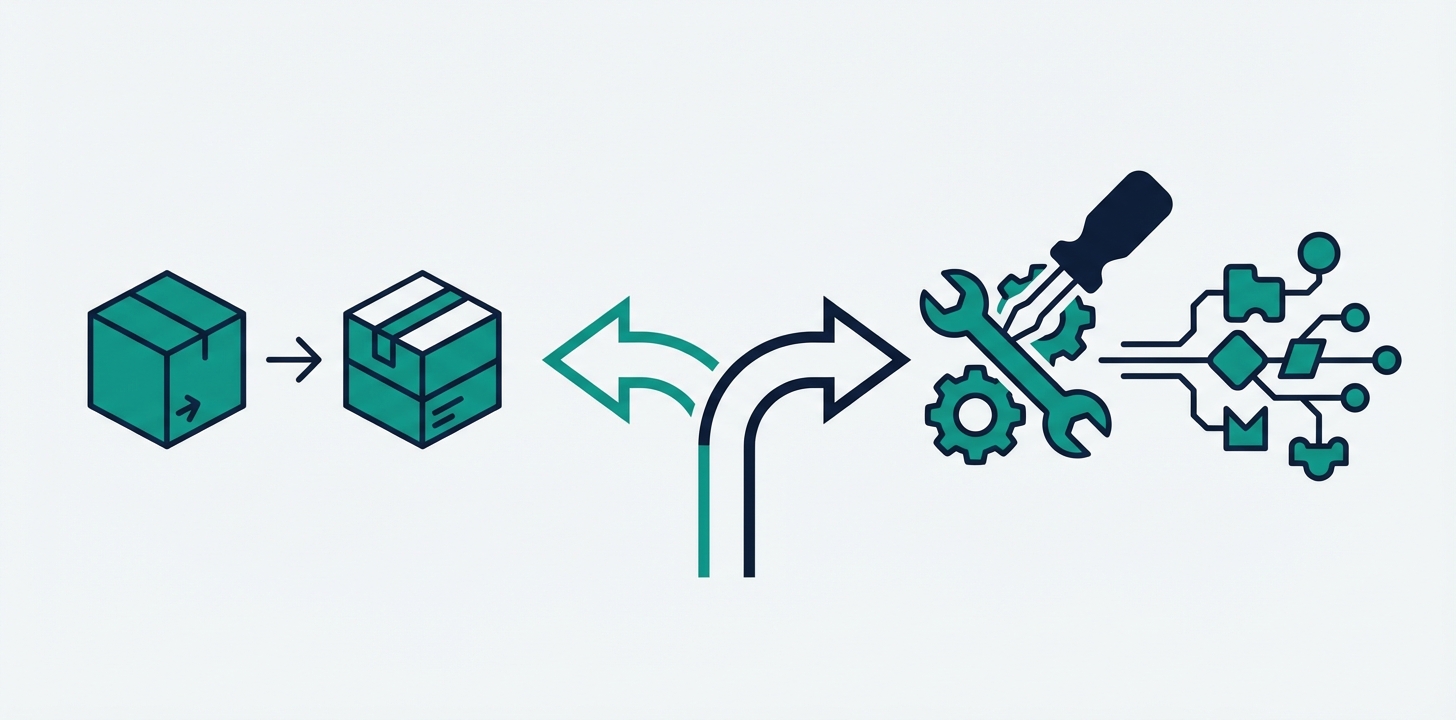
If you run a Shopify store, you have probably spent time browsing the App Store looking for that perfect tool — the one that connects your platforms, automates the tedious tasks, and just works. The App Store has thousands of options. But for many growing merchants, those generic solutions quietly hold them back.
Where generic apps fall short
Generic Shopify apps are designed to serve the broadest possible audience. That business model forces compromises that directly affect you: features you never use inflate the price, features you desperately need are missing, and the workflow the app imposes rarely matches how your business actually operates.
Feature bloat versus missing essentials
Consider a typical marketplace integration app. It might advertise support for five different marketplaces but deliver only basic order syncing for each one. If your business needs deep inventory synchronization with custom logic — splitting stock across channels, handling product bundles, or managing multi-location warehouses — you are stuck. You pay a premium for breadth when what you need is depth.
This pattern repeats across every category in the App Store. Invoicing apps that cannot handle your specific tax rules. Fulfillment apps that do not support your shipping provider. Automation tools that offer a hundred triggers but not the one you actually need.
Rigid workflows that do not bend
Every business operates differently. Maybe you need invoices created only for wholesale orders, or inventory adjustments triggered by a specific combination of events, or returns processed through a custom approval flow. Generic apps impose their own workflow on your business, and the moment you need something slightly different, you are forced into workarounds that break whenever the app pushes an update.
The most expensive software is the one that almost does what you need. You spend more time working around its limitations than you would have spent doing things manually.
Expensive pricing for limited value
Popular Shopify apps routinely charge between 50 and 300 euros per month. Some charge significantly more for "enterprise" tiers. For that price, you typically get a dashboard packed with features you will never touch, documentation that assumes your use case is standard, and support that operates through a ticketing system where your issue is one of thousands.
The cost compounds quickly. When you need three or four apps to cover different parts of your workflow — a marketplace connector, an invoicing tool, a fulfillment bridge — your monthly app spend can easily exceed what a purpose-built integration would cost.
What custom integrations do differently
A custom integration starts from your business, not from a generic template. It does exactly what you need, handles your specific edge cases, and nothing else. Here is what that looks like in practice.
Your workflow becomes the specification
Instead of adapting your operations to fit an app's assumptions, you describe how your business actually works. Need orders from Bol.com to flow into Shopify with specific tags based on product category? Need invoices in Moneybird that follow your exact tax configuration, with different rules for B2B and B2C orders? Need 3D print jobs created automatically with the correct file, material, and yield settings per product variant? A custom integration handles all of this because it was designed around your process from the start.
Lower total cost than you expect
At SyncShopify, we build custom integrations and release them as managed Shopify apps with affordable monthly pricing. No five-figure upfront development fee. No separate hosting costs. No maintenance contracts. You get a tailor-made solution at a monthly price that is often lower than the generic app it replaces — and every feature in it exists because your business needs it.
Support from the people who built it
When something goes wrong with a generic app, you submit a ticket and hope for the best. With a custom integration from SyncShopify, you are talking to the developers who designed and built your specific solution. We know your setup intimately because we created it for you. Problems get diagnosed and fixed in hours, not days.
Need a custom integration for your Shopify store?
Real integrations, real results
This is not theoretical. Here are three production integrations that demonstrate the approach:
BolSync synchronizes orders, inventory, shipments, returns, and invoice requests between Bol.com and Shopify. Merchants who switched from generic marketplace apps found that BolSync handled their specific requirements — multi-location inventory, automated invoice request processing, granular product mapping — far better than any off-the-shelf alternative.
MoneybirdSync creates invoices in Moneybird automatically from Shopify orders. It offers smart contact matching, configurable invoice rules per product tag, and automated credit invoices for returns. Generic invoicing apps cannot match this flexibility, and they typically charge more for less.
SimplyPrintSync bridges 3D printing and e-commerce by creating print jobs in SimplyPrint when Shopify orders arrive. Products are mapped by EAN, print yields are configured per item, and order statuses sync bidirectionally. This kind of niche integration simply does not exist in the App Store.
When should you go custom?
A custom integration makes the most sense when generic apps do not support your specific platform combination, when your workflow requires logic that off-the-shelf tools cannot provide, when you are paying for expensive apps but only using a small fraction of their capabilities, or when you need fast, reliable support from people who understand your exact setup.
The Shopify App Store remains a great starting point for common, well-defined tasks. But the moment your business outgrows what those generic tools can offer — and most growing stores eventually do — a custom integration becomes the smarter investment.
If you are spending too much on apps that do not quite fit, or if you need an integration that simply does not exist yet, get in touch. We will have a proposal for you within 24 hours.