Every Shopify merchant eventually faces the same question: should I install an app from the Shopify App Store, or should I invest in something built specifically for my business? The answer is not always obvious, and getting it wrong can cost you months of frustration and thousands of euros. The App Store is a remarkable ecosystem with solutions for nearly every need, but it has limits. Custom development is powerful but carries its own risks. And between these two extremes sits a middle ground that many merchants overlook entirely. This article will help you figure out which approach fits your situation.
When App Store apps work well
The Shopify App Store deserves its reputation. It is home to thousands of well-built applications that solve real problems for millions of merchants. For many use cases, an off-the-shelf app is genuinely the right choice.
Simple, well-defined needs
If your requirement is straightforward and shared by thousands of other merchants, an App Store app will almost certainly serve you well. Email marketing tools like Klaviyo, review collection apps like Judge.me, and basic SEO optimization tools are all examples of categories where the generic approach works beautifully. These needs are universal enough that app developers can build a great product for the broad market without anyone feeling underserved.
Common platform integrations
Popular integrations between Shopify and widely-used platforms often have excellent App Store options. Connecting Shopify to QuickBooks, Mailchimp, or Google Analytics is well-trodden territory. The integration points are standardized, the use cases are predictable, and the apps have been refined by years of feedback from thousands of users. There is little reason to build something custom for these connections.
Standard workflows
If your business follows a relatively standard e-commerce workflow, meaning you sell products, ship them to customers, handle returns through the normal channels, and your accounting follows conventional rules, then most App Store tools will accommodate your needs without friction. The apps were designed around exactly this kind of operation.
Signs you have outgrown generic apps
For many merchants, there comes a point where the App Store stops being a solution and starts being a source of frustration. Recognizing that point early saves you from months of increasingly painful workarounds.
You are building workarounds on top of workarounds
This is the most common sign. The app does eighty percent of what you need, so you supplement it with manual steps, spreadsheets, Zapier automations, or additional apps to cover the remaining twenty percent. Each workaround adds fragility to your workflow. When the app updates, your workarounds break. When a team member is absent, nobody knows how to run the manual steps. The accumulated complexity eventually costs more time and money than the app saves.
You need multiple apps for a single workflow
Consider a merchant who sells on Shopify and Bol.com and uses Moneybird for accounting. Without custom integrations, they might need one app for marketplace synchronization, another for invoice automation, and a third for inventory management across locations. Each app has its own dashboard, its own subscription fee, and its own logic for handling edge cases. They do not communicate with each other, so the merchant becomes the glue holding everything together. When a Bol.com order comes in, the marketplace app creates the Shopify order, but the invoicing app might not recognize the order's origin and applies the wrong tax rules. Two hours later, someone notices and fixes it manually.
You are paying for features you never use
Generic apps are priced to cover the cost of building and maintaining features for their entire user base. If you use a marketplace connector that supports fifteen marketplaces but you only sell on Bol.com, you are subsidizing the development and maintenance of fourteen integrations you will never touch. Many merchants find themselves on expensive tiers not because they need the advanced features, but because the one specific feature they require is locked behind a higher pricing plan.
Support does not understand your setup
When you contact support for a generic app, you are one of thousands of merchants with thousands of different configurations. The support agent has never seen your specific setup before and often cannot reproduce your issue. Conversations go back and forth for days, with each response asking for more screenshots or suggesting you try a generic fix that does not apply to your situation. For problems that affect your daily operations, this pace of support is unacceptable.
Need a custom integration for your Shopify store?
The middle ground most merchants miss
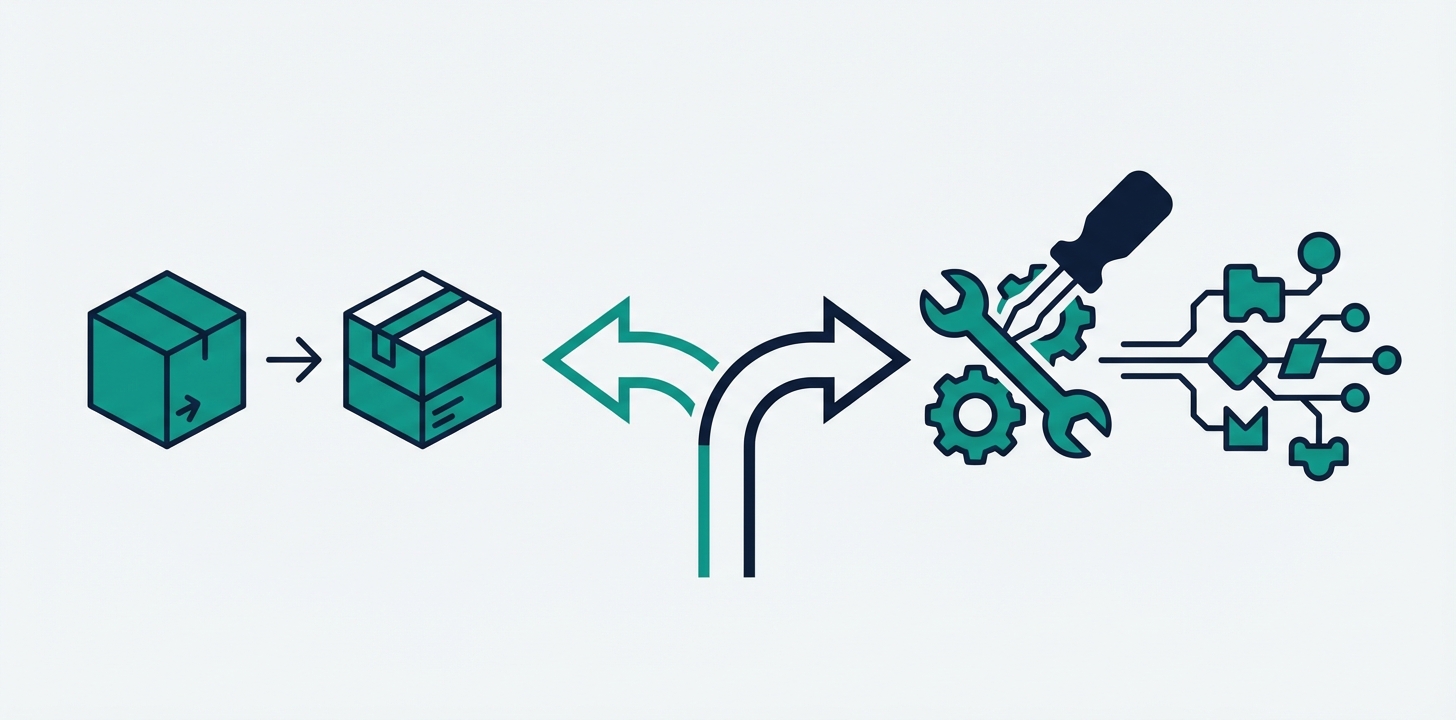
The traditional framing of this decision presents two options: cheap and generic, or expensive and custom. In reality, there is a third approach that combines the advantages of both.
Custom integrations delivered as managed apps
At SyncShopify, we build custom integrations and deliver them as managed Shopify apps with affordable monthly pricing. This is not traditional custom development where you pay a five-figure upfront fee, wait months for delivery, and then bear the ongoing costs of hosting, monitoring, and maintenance. Instead, we design the integration around your specific workflow, build it, and deliver it as a Shopify app that you install and use just like any App Store app. We handle all the infrastructure, monitoring, and updates.
The monthly cost is often comparable to, or lower than, the generic apps it replaces. But every feature in the app exists because your business needs it, and the people who provide support are the same developers who built the solution. This model works because the underlying technology platform that powers our integrations is reusable across clients, even though each integration's business logic is unique to the merchant.
Real examples of this approach
Our BolSync integration connects Shopify with Bol.com, handling order imports, bidirectional inventory sync, shipment tracking, returns, and invoice requests. It was built for the specific needs of Dutch merchants selling on both platforms, and it handles the nuances that generic marketplace connectors miss.
MoneybirdSync automates invoice creation in Moneybird from Shopify orders, with smart contact matching, configurable rules per product tag, and automated credit invoices for returns. It does one thing, does it deeply, and costs less than the generic invoicing apps that try to support every accounting platform on the market.
SimplyPrintSync creates 3D print jobs in SimplyPrint when Shopify orders arrive. This is the kind of niche integration that will never exist in the App Store because the market is too small for a generic app developer to pursue. But for the merchants who need it, it transforms their operations.
Five questions to help you decide
When you are evaluating whether to use an App Store app or pursue a custom solution, working through these five questions will clarify the right path for your business.
First, ask yourself whether your requirement is truly standard. If thousands of other Shopify merchants need exactly the same thing, an App Store app is probably the right choice. If your workflow involves custom logic, unusual platform combinations, or business rules specific to your operation, it probably is not.
Second, count the workarounds. If you can install one app and it handles your need completely without manual steps or supplementary tools, that is a strong signal that the generic approach works. If you need to bolt on spreadsheets, Zapier automations, or additional apps, you are already in custom territory whether you realize it or not.
Third, calculate the total cost. Add up every app subscription involved in a single workflow, plus the labor cost of any manual steps that bridge the gaps between them. Compare that total to the cost of a single purpose-built solution. Many merchants are surprised to find that the custom route is actually cheaper when all costs are counted.
Fourth, consider how critical the workflow is to your business. For non-essential nice-to-have features, a generic app that is good enough is fine. For core operational workflows, such as order processing, inventory management, and invoicing, the reliability and precision of a custom solution often pays for itself through error reduction alone.
Fifth, think about where your business will be in twelve months. If you are growing rapidly, the limitations of generic apps will become more painful over time, not less. Investing in the right solution now avoids a more costly and disruptive migration later.
How SyncShopify approaches it
When a merchant comes to us, we start by understanding their current workflow, the tools they use, and the specific pain points they experience. Sometimes the honest answer is that an App Store app will serve them perfectly, and we tell them that. We are not interested in building custom solutions for problems that are already well-solved by existing tools.
But when the conversation reveals workflow complexity that generic apps cannot handle, unusual platform combinations, or a stack of workarounds that is slowly collapsing under its own weight, we design a solution tailored to that specific situation. We scope the integration, provide a fixed monthly price, and deliver a working Shopify app typically within one to four weeks. The merchant installs it, their workflow is automated, and we handle everything behind the scenes from that point forward.
The choice between the App Store and custom development is not about one being better than the other. It is about matching the right approach to your specific needs. If you are unsure which category your situation falls into, get in touch. We will give you an honest assessment and, if a custom solution makes sense, a proposal within 24 hours.